
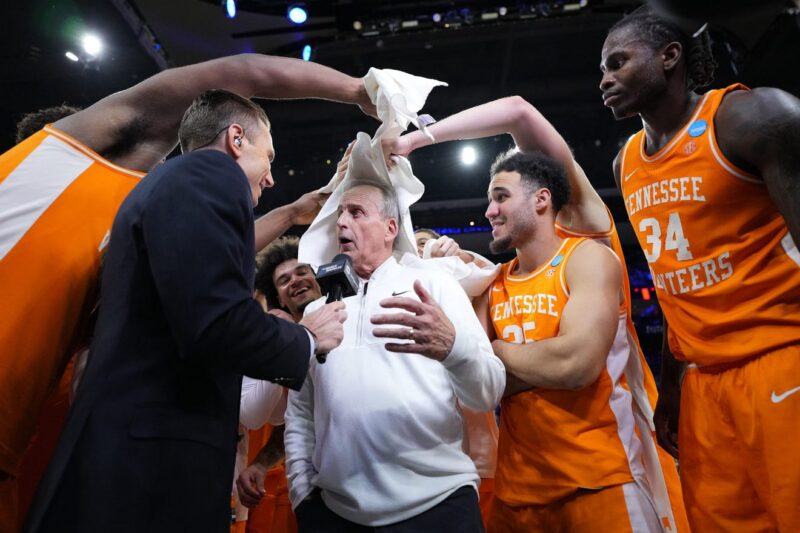
CHICAGO — Rick Barnes didn’t give the canned answer like Alabama’s Nate Oats and Iowa State’s T.J. Otzelberger had to because nobody really figured it was worth asking anymore.
“I’m from North Carolina,” the 71-year-old Tennessee men’s basketball coach quipped when told he was likely to be the only head coach at the 2026 NCAA Tournament’s Midwest regional to not have to address the job opening currently driving the college basketball coaching carousel conversation.
But the Hickory, North Carolina native is also from another era, joining Michigan State’s Tom Izzo and Houston’s Kelvin Sampson from the old guard of coaches to make it to the Sweet 16 this year. His No. 6 seeded Tennessee team faces No. 2 seed Iowa State Friday, March 27 at the United Center in Chicago.
With that longevity comes a fascinating perspective about the place he’s been for the past decade, the places he might have left for previously, and the places he probably won’t go now that everything about college sports is different.
“The obvious problem today is there’s some fan bases that still think they have an entitlement and they think it’s going to be the same way,” Barnes said on Thursday in reference to North Carolina basketballl. “The game has changed totally because of NIL.”
The statement perhaps minimizes the remarkable consistency forged under Barnes over the past decade on Rocky Top. This is the fourth Sweet 16 appearance in a row for Tennessee under Barnes, and no active coach has more all-time wins (860) without winning a national championship. The Vols have advanced past the first weekend of the men’s NCAA Tournament nearly as many times with Barnes (5) as they had in the previous 106 seasons of program history.
He’s also 23 years removed from a Final Four appearance with Texas and may never be on another blueblood wish list again because of his age and the lifetime contract he signed with the Volunteers last year. But now, with his coaching career much closer to its ending than the beginning, he might not need to be.
That’s what he believes, and so do his counterparts actually being featured on all those UNC hot boards this week. The 2025-26 college football season was proof of concept for some.
“We may not have the tradition that some of these other places had,” Oats said in reference to Alabama, for instance, “but Indiana football probably didn’t have that tradition, either, and they won it. I think their athletic department supported them, they got a good coach and they won it.”
This alignment between administration and coach, Barnes emphasized Thursday, is more important than ever in a system he acknowledged as “broken” because of the rapid evolution of the NCAA rulebook. “You need money. We know that,” Barnes said. “But there’s a lot more to it than that.”
There’s a scenario, for instance, in which he would have already retired in the wake of all the change in college basketball if not for the presence of Tennessee athletic director Danny White.
“I love coaching, and if I didn’t have the leadership – I don’t know,” Barnes said.
In this way, perhaps coincidentally, he has been ahead of the curve working at a school with a powerhouse football program.
Barnes called Tennessee football the “greatest asset we have,” rather than competition for resources, due to the revenue generated and the value of hosting recruits during games at Neyland Stadium in the fall. He joked NIL stands for “now it’s legal,” and yet the version of Barnes players get now seems a lot like the version they got before making six- and seven-figure salaries.
His recruiting pitch even includes the warning that, “this will be the hardest-working program you’ll ever be in,” Ohio State transfer Felix Okpara said.
“He’s as hands on as it gets. He’s ripping into you,” added guard Bishop Boswell. “A lot of times it can be hard to hear, but at the end of the day, he demands perfection. I think the thing we respect the most about him is he’s the same every day. There’s no fall off, even if we might not always want to hear it.”
Barnes savors this part of the job. He loves practice most of all, he said, and told a story Thursday from when he worked for Wimp Sanderson at Alabama 40 years ago.
Barnes walked in on Sanderson “literally lying on the sofa in his office” with his hands behind his head before the first game of the season, and the coach told Barnes this would be a great job “if you never had to play games.” Only Barnes lost his train of thought as the memory flooded back to him and asked to hear the question again.
What’s his driving force after so many years, so many accomplishments and so many changes? This time, Barnes gave the canned answer.
“You don’t ever take it for granted,” he said.